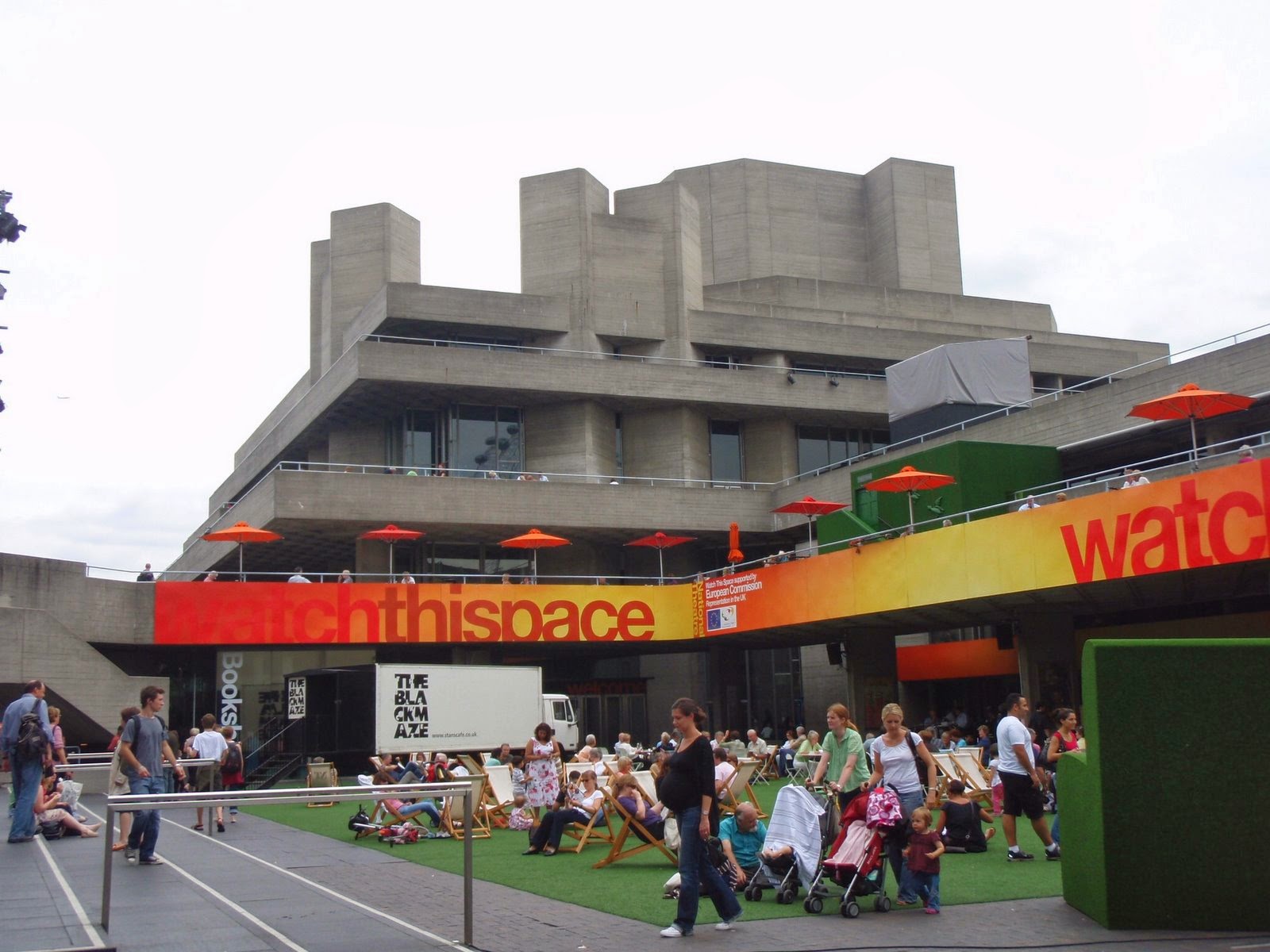
Mother Courage and Her Children (National Theatre, 10th September 2009)

Yes – I was there that night.  That’s my feeling looking back at my experience at the Preview of the National Theatre’s Mother Courage and Her Children.  The pre-show was a busy chaotic affair and it felt like the lines between setting up the show and the show itself were blurred.  The sound of an explosion every now and again created some tension.  However, the pre-show seemed to go on and on and it didn’t  seem to be going anywhere.   Then the director took a mic on stage and introduced herself.  Deborah Warner then informed us that the cast had been working up to 5 pm, but hadn’t finished to the technical side and as there was a danger to the cast so they were going to perform the play as far as the interval.  Deborah Warner then went on to say that if anyone left they could get a refund, but if the audience chose to stay they could also ask for a refund.  Some got up to go.  Others got up and came back.  Most of us stayed.

I must admit that I wasn’t sure if this was really going to happen and that this was just part of the performance or that the performance would stop at the point when the interval was to take place.  The performance was an eclectic mix of things.  There was a use of multi media which I thought worked much better than in Julius Caesarat the RSC.  Yes Fiona Shaw can’t sing beautifully but her singing added to the performance and I really liked the way the backing band could mimic her voice.  No this wasn’t the seventeenth century with its floral deck chairs and a wagon that would look in place at the side of a busy road.  I was surprised, mystified, entertained and I enjoyed what I saw. 

So when the interval came nearly two and half hours later, I really felt that I had seen enough.  There was another six scenes to go.  Was it an interval or not?  There was a curtain call.  Some people stood up to applaud and others cheered.  My interval drink wasn’t poured, but the glass stood on the bar empty in case I wanted my drink.  I travel a long way to the National and I won’t be able to find the time or money to come back to see this production.  Was I disappointed?  Not really.  It had been a theatre going experience that I will remember and yes two and the half hours was worth my money.

Articles

Mother Courage delays Press Night (What’s On Stage)
Mother Courage – The Preview that Wasn’t in The Guardian
Mother Courage rehearsal diary in The Times


Phedre (National Theatre, 1st August 2009)

I said that I would write about the live experience of seeing Phedre at the National Theatre in contrast to seeing it at the cinema.  I did enjoy the cinema experience, but I enjoyed seeing the live production much more.  I felt that it was much more physical live and the story was more powerful.  I also found it great not to be directed to look in certain places by the camera, but to be able to   look at reactions to speeches from other actors.  Again, I liked the idea of not having an interval, as the play worked well being performed in one go and seemed to fall nicely into two segments.  The first being before Theseus returns and the second after. 

I felt that the set was as stunning in the theatre as in the cinema and the blue was amazing.  Yes both the cinema and theatre experiences were great, but I did prefer the Theatre experience in the end.

 
Reviews and Previews

All's Well That Ends Well (National Theatre, 11th July 2009)

Once upon a time……. in a castle on the mountain where the ravens croaked, the young girl mourned the death of her physician father brought up by the Countess Rossillion. Rossillion was a dark place. Then Helena fell in love with the Countess’ son, Bertram, and it should have ended happily ever after. For her wedding Helena wore a beautiful jewel encrusted white dress. But all was not well. Bertram did not love his bride and after a journey across Europe…..all’s well that ends well.

The National Theatre’s All’s Well that Ends Well is a beautiful production taking all the elements of a fairy story and adding the sense of being in an animated world. Using shadows and silhouettes to great effect, as an audience we are not sure what is real and what isn’t. Starting with a darkened stage the productions becomes lit as the action moves towards resolution. With its stunning set and wonderful performances, Marianne Elliot’s production of All’s Well That Ends Well is well worth a visit. This is one of the best things I have seen this season. It will be great to see it on NTlive, but I’m not sure that the cinema experience will be a substitute for being in the Olivier while all is revealed before you.

Reviews and Previews

Alls Well Review
Theatre review: All’s well when fish fall out o…
Evening Standard All’s Well
All’s Well That End’s Well
Marianne Elliott: explorer of the heart – Times…
Billington Review of All’s Well
Official London Guide review of All’s Well
The Stage’s review of Alls Well
FT.com / Arts / Theatre & Dance – All’s Well Th…

Phedre (City Screen/National Theatre, 25th June 2009)


Film and Theatre are very different, and this is why it felt so strange in a cinema watching actors with bold gestures projecting their voices so the back of the stalls can hear them. The experiment, I think was a success, but only because I was always mindful that this was a live stream from a theatre, and not a cinematic version of the National Theatre production. I think a production made specifically for the cinema/DVD would be very different from a stage production and we’ll see whether this is the case with the RSC Hamlet. I found it strange that in the cinema there was no sense of the audience in the National Theatre. I felt the picture was crisp, and the set worked so well on the cinema screen. I saw the set when I went to the Antony Sher platform and in the Lyttleton it feels like a claustrophobic space, which isn’t so evident in the cinema. The blue backdrop was perfect in representing the exterior scenes. In this play, there are no comic moments, so it is a very tense two hours sat in such a hot cinema, and I felt that not having the interval worked well.

The next production to be streamed live will be All’s Well That End’s Well and that will have an interval. It will be interesting to see if all the audience can get back from the bar in time, without House managers to monitor progress of return of the audience as in the Theatre.

Do you clap at the end when you’re sat in the cinema? The actors can’t respond to you to acknowledge the applause if you do. Only a few people clapped in the cinema where I watched the film, and I must admit I was torn whether to appleaud or not.

I’m going to see Phedre live at the National soon. I think I would have preferred to have done this the other way round, but I am looking forward to seeing it really live. I shall blog about it again then.

Reviews and Previews

Mark Lawson on Phedre in the cinema
Preview – Phedre in the cinema
Michael Billington on the filming of Phedre
Phedre screening (Independent)
New Statesman on Phedre screening
Phedre in the Telegraph

Antony Sher Exhibition (National Theatre, 20th June 2009)

On encountering Antony Sher’s large work The Audience in the foyer of the Lyttleton Theatre at the National Theatre, I realise that the subject matter also touches on my own life as at points I’ve encountered the portrayals characters in the painting. Richard III was the first play, I saw at the RSC, and twenty years later, I was to see The Tempest (see blog posts Tempest at RSC Courtyard and Sheffield Lyceum).

The Audience is a large painting showing figures who had had an influence on Antony Sher’s life, whether they are friends, family, artists or notorious public figures. The montage is interesting because there are empty seats, whether these are the gaps for those Sher would have wanted to be part of his life or for those who he has chosen not to represent. As Sher said, in his National Theatre Platform appearance, there are empty seats at most performances and he wanted to show these. The Audience brings together many of Sher’s works shown in the rest of the exhibition such as the ‘bottled spider’, his Richard III sketch carried out preparing for the part in 1984 and the portraits of actors and partners past and present – Greg Doran, Mark Rylance, Jim Hooper. Sher’s characters, such as Richard, Shylock, Macbeth, Stanley Spencer, Primo Levi sit alongside real people. In one section Sher portrays artists who have influenced him including Michelangelo and Dali. As well as actors who he has worked with, or he is friends with, there are the actors who have influenced Sher. There is Sher’s representation 0f Laurence Olivier, as Richard III, whose image hovers over Sher in The Year of the King and a portrait of Judi Dench. Then there are those people that are disturbing. No one wants to sit next to Hitler except his younger self and Idi Armin looks threaten from the back row.

I felt that the painting is autobiographical and is also autobiography. The painting is not only portraiture, it presents moods and images that capture Sher’s emotions and feelings about his life, and becomes a visual narrative about ‘his journey’ through his career and personal life clearly both intertwined. For example, the beautiful image of a young Greg Doran clearly conveys the painter’s delight in this person and the marriage portrait conveys feelings of joy. In contrast the image of Sher snorting cocaine and the fragment from the intriguing Three Generations of the male Sher line (painted in cocaine and Sher’s father’s ashes). Sher’s pride in creating characters on stage is conveyed in the image, as well as the tensions in working on character such as on Macbeth.

I have always felt reading Sher’s autobiographical works that he has always tried to label himself, and has been very open about being ‘the other’. Is he an actor, or writer or artist? He talks about being in so many closets – being gay, Jewish, white South African – and his autobiographical work also discusses coming out of those closets. It feels very much with the exhibition in the National Theatre, and the reissue of his autobiography Beside Myself , that Sher is now comfortable being an artist, writer and actor all at the same time and doesn’t have to be one while the rest become subsidiary.

Information

http://www.nationaltheatre.org.uk/45950/exhibitions/antony-sher-paintings.html


Previews and Review

Antony Sher Exhibition review in the Financial Times
Review of Antony Sher paintings

Bibliograpy

Branagh, Kenneth. (1989). Beginning. London: Chatto and Windus

Sher, Antony. (1985) Year of the King. London: Methuen

Sher Antony (1987) Characters. London: Nick Hern Books

Sher Antony. (1997) Woza Shakespeare. London: Methuen

Sher, Antony. (2001) Beside Myself. London: Hutchinson (reissued in paperback by Nick Hern Books 2008 includes new forward, and image of The Audience)

Sher, Antony. (2005) Primo Time. London: Nick Hern Books

Sher, Antony (2006) in The Way We Are Now, ed. Ben Summerskill. London: Continuum