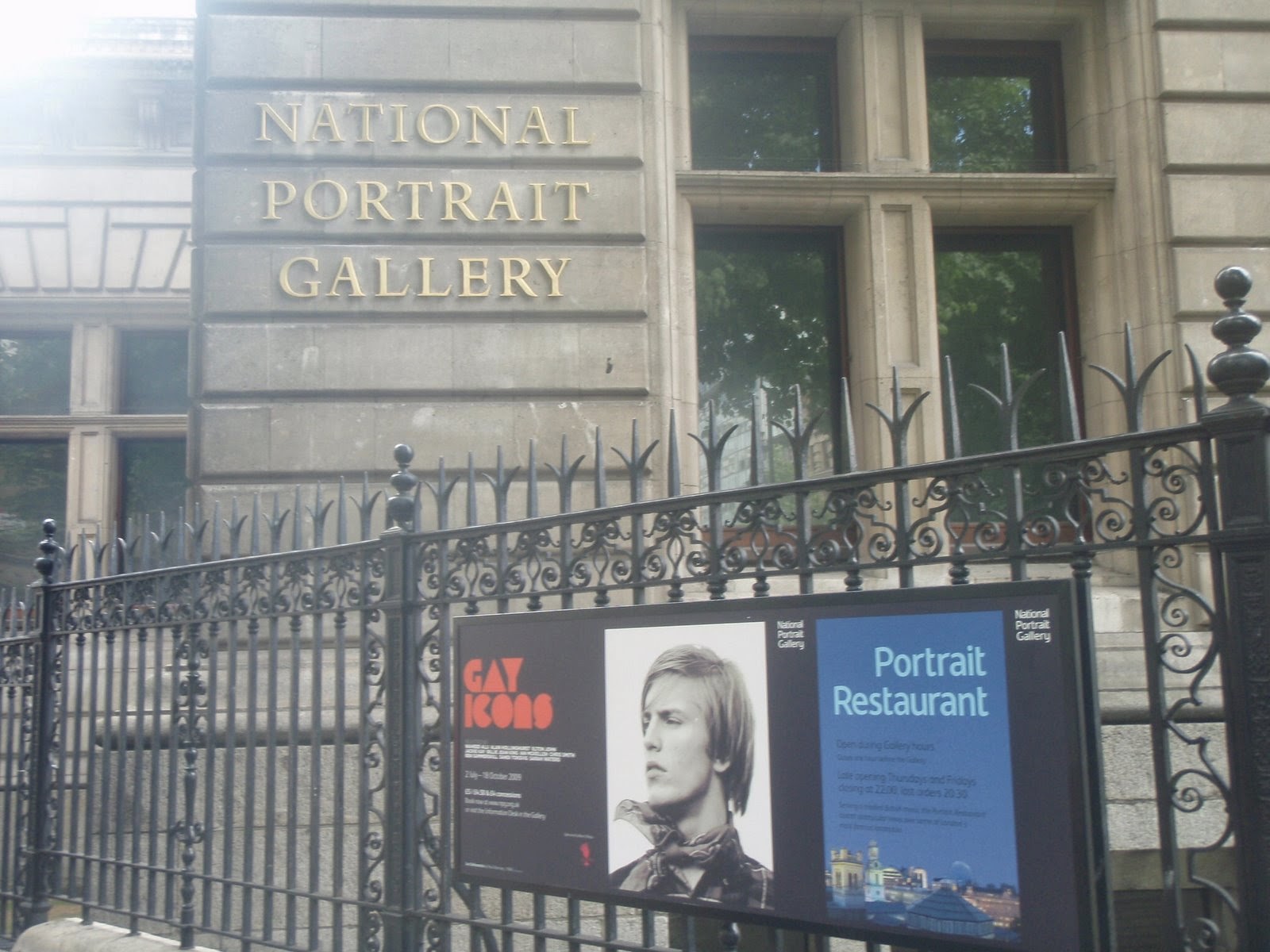
Gay Icons (National Potrait Gallery, 18th July 2009)

I really like visiting the National Portrait Gallery because I feel that I am getting close to people in a non intrusive way. I particularly enjoyed the Gay Icons exhibition for three reasons. Firstly, my interest in the ten panel members who made the selections, secondly for their selections, and thirdly for the reasons for their selections.

The panel of artists, writers, entertainers, athletes, campaigners and politicians are icons themselves. Chaired by Sandi Toksvig, the panel had to make a selection of their icons, but also include a portrait of themselves. I found the images of the panel as interesting as the ones the panel members chose and I found their lives as interesting.

The icons chosen by the panel are a mix of people from different walks of life, but are remarkable and have contributed enormously to art and politics. I loved the photograph of Martina Navratilova and the comment that accompanied it. That ‘knowing look’ was so inspiring. The photograph of KD Lang was mesmerising and captures a unique beauty. The champion tennis player, Billie Jean King chose to display images of people close to her, whilst Elton John chose people who had reached the top of their fields such as the former England manager, Graham Taylor and John Lennon.

The short descriptions of why the images were chosen were often personal and celebratory, recognising both the achievement of the person chosen and the personal reasons why the panel member had chosen the person as an icon. Chris Smith chooses the writer, Virginia Woolf who killed herself as two other people in his selections. Sandi Toksvig displays a portrait of the activist Peter Thatchell because of his campaigning work. In contrast, Lord Waheed Alli’s selection included entertainers who inspired and entertained a generation such as Village People and Will Young, but he also includes the Paul O’Grady character Lily Savage. I wasn’t sure if he meant Lily Savage or Paul O’Grady. I thought Lord Ali was the most interesting person in his selection, and I think this was why this exhibition is so good. It is of interest on a number of levels and I moved quickly round as I was so inquisiive to see who had been chosen and why.

Reviews and Previews

Gay Icons (Observer)
Gay Icons (Newsnight Review)
Gay Icons (Evening Standard)
Gay Icons (Times)
Gay Icons (Guardian)

Catalogue

Dyer, Richard and Toksvig Sandi. (2009) Gay Icons. London: National Portrait Gallery

Further Information

Gay Icons on the National Portrait Gallery Website

Constable Portraits (National Portrait Gallery, 2nd May 2009)

The Constable exhibition is a much smaller exhibition than the Richler exhibition showing a range of Constable’s works that we don’t always see as we normally experience his landscapes. The exhibition is series of portraits of Constable’s family, close friends and associates.

The catalogue does say that , “Famously, constable once observed that painting is another word for feeling'” (Gayford, 2009, p.15). For me, this felt like an important part of the exhibition. The use of tones and oil presents the sitters with her real warmth and tenderness. This would make sense if the portrait of Ann Constable is by Constable, showing an empathy with the sitter. In looking at portraits which are of Constable’s family, I felt that I was getting an insight into Constable’s personal world.

Reviews and Previews

FT.com / Columnists / Jackie Wullschlager – Con…
Constable’s parents captured on canvas – Telegraph
Constable Portraits: The Painter and His Circle…
John Constable and Gerhard Richter have link – …

Catalogue

Gayford M. and Lyles A. (2009) Constable Portraits London, National Portrait Gallery

Gerhard Richter (National Portrait Gallery, 2nd May 2009)

I experienced this exhibition as an exploration of blurring reality both literally and metaphorically. I was fascinated by the images in this exhibition, and it felt really uncomfortable looking at some of the images which are actually blurred, in contrast to viewing images in recent exhibitions such as the Face 2008 and the Annie Leibovitz exhibitions. Many of the paintings in the exhibition are based on photographs, and the use of oil on canvas, the effect feels like watching a film in slow motion. Richter’s technique signals to me that this is a key powerful moment, and a moment of expectation that something is about to happen. For example, the portrait of Bridget Bardot and her mother titled, ‘Mutter und Tochter‘, conveys the sense of the two women walking down the street as if captures a a moment in time. Bardot looks as if she is about to smile and her mother looks secure and confident as if she is supporting the slightly anxious daughter. When observing the image, I felt that I was trying to anticipate the moments that are to follow.

Other images in the exhibition such as images produced after the death of Kennedy attempt to take subjects out of context and in doing this makes them even more unsettling. In contrast some works deal with the personal such as ‘Gilbert and George’ which fuses the two men’s profiles together and several portraits of the artists’ daughter Betty.

Reviews and Previews


Gerhard Richter at National Portrait Gallery, L…
Gerhard Richter portraits are ripe with emotion…
Photos and fantasy: Gerhard Richter’s portraits…
Gerhard Richter at the National Portrait Galler
FT.com / Arts / Visual Arts – Faces from an abs…
My week: Diana Widmaier-Picasso – Times Online
Richter
FT.com / Arts / Visual Arts – A painter’s relat